Moving beyond the five stages of grief
Why it’s an ineffective model and two alternatives
The five stages of grief are everywhere. They’re referenced in books, TV shows, and movies, and they were probably the first thing I ever learned about grief, long before any death doula or thanatology training.
Recently I noticed a local hospice agency referencing them in a volunteer training guide, and the brochure the vet gave me when my cats died referenced them too.
But here’s the thing—the five stages are not an empirically proven model of the process of adaptation after loss (O’Connor, 2023), and research suggests retiring them in favor of other models (Corr, 2019).
Origin story
Dr. Elisabeth Kübler-Ross introduced the five stages of grief in 1969, after conducting clinical interviews with adults who were dying of a terminal illness. She adapted an existing stage theory of grief developed by Bowlby and Parkes to describe a sequence of responses she observed from interviewees regarding their impending death—denial, anger, bargaining, depression, and acceptance (Maciejewski et al., 2007). As a model, it took off, and by 1997, the majority of nursing and medicine programs reported using it heavily in their death education curriculum (Downe-Wamboldt & Tamlyn, 1997).
Limitations
Its popularity makes sense—it presents a linear, predictable course of behavior with a clear end (Corr, 2019), not unlike the hero’s journey (O’Connor, 2023). And to be clear, Kübler-Ross’s work was groundbreaking stuff. In an overly medicalized death system, she resurfaced the human aspects of dying and demanded professionals actively listen to and learn from dying people, as they are still living and ought to be treated as such (Corr, 2021). Much credit is due to her here.
However research has since shown that as a model, its limitations make it inaccurate and incomplete (O’Connor, 2023).
No empirical support
Since it first showed up in 1969, the model has never been independently confirmed valid or reliable, and Kübler-Ross herself offered no additional evidence on its behalf before her death in 2004 (Corr, 2019). Thus, there is no empirical evidence for a universal, linear stage theory of grief (Corr, 2021; O’Connor, 2023).
Too linear, not unified
There is danger in a descriptive model turning into a prescriptive guideline (Stroebe et al., 2017; O’Connor, 2023), and considering the stages as fixed and universal can actually harm people (Cavanaugh & Blanchard-Fields, 2019). Further, the interviews in her book do not describe a single individual going through all five stages, calling into question the existence of a unified process (Corr, 2019, 2021).
Not for bereaved people
Finally, Kübler-Ross interviewed people who were dying to formulate the stages, and there is a significant difference between coping with terminal illness and coping with grief over a wide variety of losses (Corr, 2021). Her work had no foundation in bereaved individuals or their experiences after the death of a significant other (Corr, 2019).
“Attempts to employ the five stages of grief in either education or practice should be promptly abandoned and never resuscitated.”
Researchers agree that the five stages of grief are important historically, but should be taught in death education spaces only if the model’s limitations are also discussed.
Two alternative grief models
There are other grief models out there that emphasize mourning as an active process, rather than a staged one. The two below are among my favorite learnings from the thanatology program.
Dual-process model of coping with bereavement
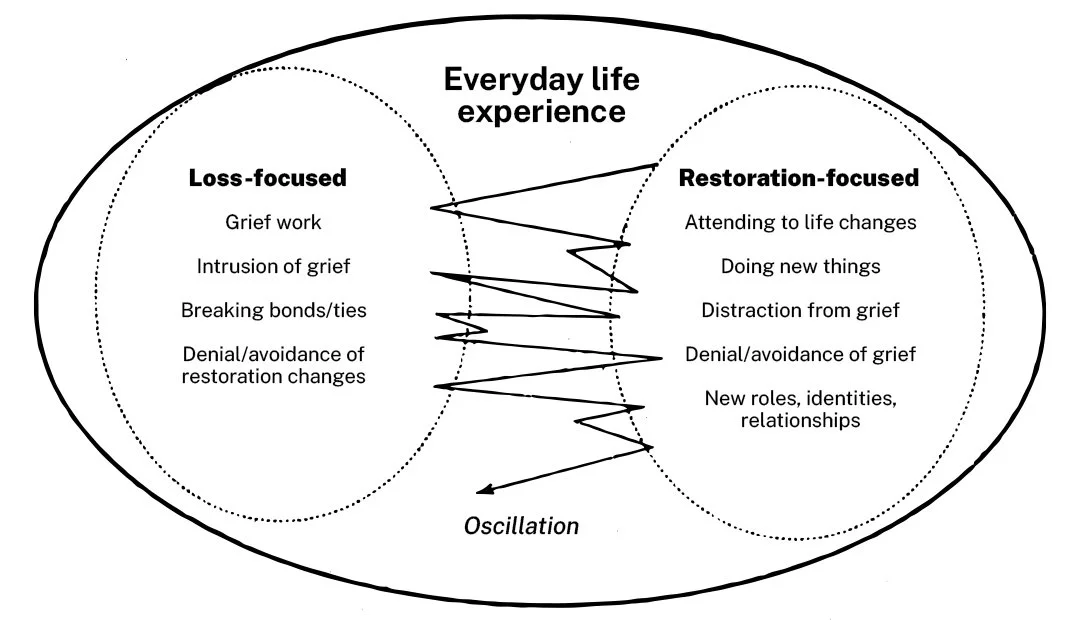
Developed by Stroebe & Schut (1999), this model tries to represent the dynamic processing characteristic of grieving.
The key word for this model is oscillation. At any given time, someone who is grieving may oscillate between two types of stressors after someone dies:
Loss-orientated thoughts and behaviors: focus on the grief and the relationship with the deceased
Restoration-oriented thoughts and behaviors: focus on adaptation to life without the deceased
Like O’Connor (2023), I appreciate how this model acknowledges both poles as important to the experience of grieving and permissions flexibility in the day-to-day movement between them. Stroebe & Shut (1999) called this “dosing” grief and argued it’s an integral part of adaptive coping.
“Restoring a meaningful life requires flexibly moving our attention from thinking about the past to thinking about the present and the future.”
The four tasks of mourning
Another good model comes from Worden (1982), who offered an action-based task model as an alternative to the five stages:
Four tasks of mourning
Accept the reality of the loss
Process the pain of grief
Adjust to a world without the deceased
Find an enduring connection with the deceased
Task-based models like this one seek to empower the grieving person trying to cope (Doka, 1996), and I like how it allows for generalization while preserving individuality (Corr, 2021). Grievers can choose which tasks to engage with and approach them in their own way. I think it also pairs nicely with the dual-process model—the tasks acknowledge the presence of both loss and restoration in the grieving process.
Ultimately, Kübler-Ross was a champ for laying down the grief research groundwork, and the five stages deserve a place of historical importance (Corr, 2021). However now that we know more, we can better serve grief and grievers by letting them go.
References
Cavanaugh J. C., & Blanchard-Fields F. (2019). Adult development and aging (8th ed.). Boston, MA: Cengage.
Corr, C. A. (2019). The ‘five stages’ in coping with dying and bereavement: Strengths, weaknesses and some alternatives. Mortality, 24(4), 405–417. https://doi.org/10.1080/13576275.2018.1527826
Corr, C. A. (2021). Should we incorporate the work of Elisabeth Kübler-Ross in our current teaching and practice and, if so, how? OMEGA - Journal of Death and Dying, 83(4), 706–728. https://doi.org/10.1177/0030222819865397
Corr, C. A., Corr, D. M., & Doka, K. J. (2019). Death & dying, life & living (8th ed.). Cengage.
Doka, K. J. (1996). Coping with life-threatening illness: A task-based approach. OMEGA - Journal of Death & Dying, 32(2), 111–122. https://doi.org/10.2190/0WEH-QUBG-67VG-YKJK
Downe-Wamboldt, B., & Tamlyn, D. (1997). An international survey of death education trends in faculties of nursing and medicine. Death Studies, 21(2), 177–188. https://doi.org/10.1080/074811897202065
Kübler-Ross, E. (1969). On death and dying. New York: Macmillan.
Maciejewski, P. K., Zhang, B., Block, S. D., & Prigerson, H. G. (2007). An empirical examination of the stage theory of grief. JAMA: Journal of the American Medical Association, 297(7), 716–723. https://doi.org/10.1001/jama.297.7.716
O'Connor, M. (2023). The grieving brain: The surprising science of how we learn from love and loss. HarperOne.
Stroebe, M., & Schut, H. (1999). The dual process model of coping with bereavement: Rationale and description. Death Studies, 23(3), 197–224. https://doi.org/10.1080/074811899201046
Stroebe, M., Schut, H., & Boerner, K. (2017). Cautioning health-care professionals: Bereaved persons are misguided through the stages of grief. OMEGA - Journal of Death and Dying, 74(4), 455–473. https://doi.org/10.1177/0030222817691870
Worden, J. W. (1982). Grief counseling and grief therapy: A handbook for the mental health practitioner. New York: Springer.