What the heck is thanatology?
And who the heck am I? An essay on thanatology and my relationship to work
I had never heard the word “thanatology” until a friend said it on a call.
We had just finished a six-week death doula training together, and in discussing next steps, she mentioned a book written by a thanatologist. I stopped her mid-sentence to look the word up, because I felt a tiny little bell ring in my nervous system.
The study of death and dying! I had no idea it existed.
“Thanatology is the cross-disciplinary study of dying, death, loss, and grief and is both an academic and applied discipline.”
I ended that call with the very best kind of bee in my bonnet—a wiggly one. My subsequent searches for more information pointed me to two universities offering master’s degrees in the subject, and learning that felt like a locked door clicking open after a decade of banging my head against it.
Career crash out
Speaking to my working self, I grew up in the technical writing world. I got a job writing software manuals right out of college in 2008, then bopped around corporate America as a copywriter, a graphic designer, and finally a copyeditor.
I was a millennial tech worker worshipping at the feet of neoliberal promises those corporations could never keep (Harvey, 2005). Except I didn’t know that at the time. I really thought it was a personal problem, my inability to keep up with the machine. And I didn’t know why I was burning out at every job somewhere around the one-year mark—I figured I was just an asshole and tried harder to fit in.
But 2018-2020 sent cosmic crash outs so loud I had no choice but to sit down, gird my loins, and look it all in the face.
And when I did that, I found grief.
Lots and lots and lots of grief.
Big wells of little Amy heartsick.
And from that place, I turned into a very gelatinous chrysalis goo. And a very gentle art therapist put crayons in my hands. And together we investigated those wells and swells and gales of heartsick.
There were so many stories in there! Some of my own making, others lodged there by my ancestors’ tangled embrace with the Protestant work ethic and capitalism (Weber, 2002). It was a time of sorting and sifting, and when I got an Autism/OCD diagnosis in 2022, all those stories melted into more goo under a new lens of self-understanding. This coincided with a political awakening, by way of Federici (2004), Zinn (2015), and the mass death/uprisings of 2020. And by that point, I knew I could no longer do the jobs I used to apply for. I had to radically shift my relationship to work and labor, so I started rethinking everything I thought I knew about my working self.
And that’s when I found death work.
The original call to death work
I followed a handful of death doulas on Instagram sometime in 2021, passively but curiously. I knew what birth doulas did, and I was moved by the idea of extending that care to the end of life. I thought nothing of this until 2023, when I moved back home to Salt Lake City after nine years in Seattle. I was grieving this move hard—so hard. And on a particularly desperate day, I signed up for a death doula 101 class. Just to see what it would be like. And to my surprise, I loved it.
I loved learning about the death process start to finish. I loved learning about home funerals and natural burial, and I was ready to fight when I learned about embalming and how it’s not required by federal or state law (Federal Trade Commission, 2012). I also loved learning about grief and how to witness it through ritual.
More than anything else, though, I noticed a nascent seed with a tiny little megaphone telling me I could, in fact, do care work.
I had long written off that possibility, certain I couldn’t do the math, science, or viscera required of hospice nurses or funeral directors who must embalm to be licensed (as they do in Utah). I was also certain that because I had hidden behind computers all my life, I was bad with people, and I could never handle the social demands of care work. But here was a niche role that worked alongside those death care professionals—a nonmedical role with a scope I felt I could meet—and my intuition said go with it.
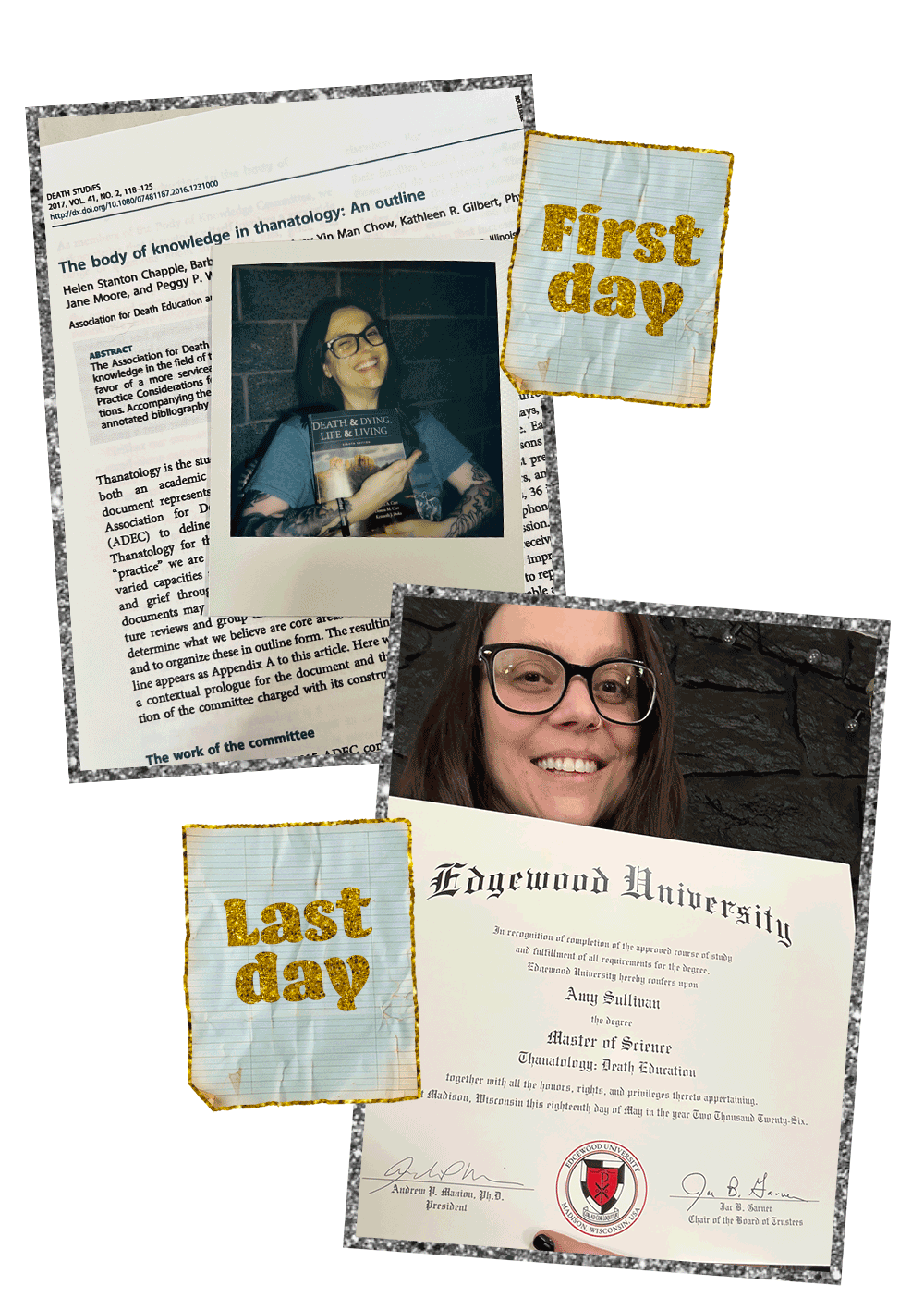
So I took the six-week training, where this story started, and met the friend who shared the word “thanatology” with me. A keyword I had been missing in the previous searches for graduate programs that could support my intersecting interests of writing, history, sociology, archival, and research. Nothing out there had ever made any sense to pursue, until this word showed up and bridged all my interests together, with care work at the center of it all. And two years later, in 2026, I graduated from the thanatology program at Edgewood University.
What I liked about the thanatology degree
I was most excited by the interdisciplinary aspect of thanatology. I shared class space with funeral directors, nurses, chaplains, social workers, therapists, donor services workers, and even fellow death doulas, all of whom taught me something about America’s death system and how it’s failing people.
The classes covered individual and social aspects of death, and we engaged with not only research but also art exploring humanity’s relationship to grief and bereavement. While it varies for each student, my class schedule ended up looking like this:
Intro to thanatology
Application of thanatological theory
Family systems and thanatology
Spiritual dimensions of care
Ethics in death and dying
The self and openness to culture
Research methods and thanatology
Hospice and palliative care
Death education and grief support
Death and the creative imagination
Suicidology
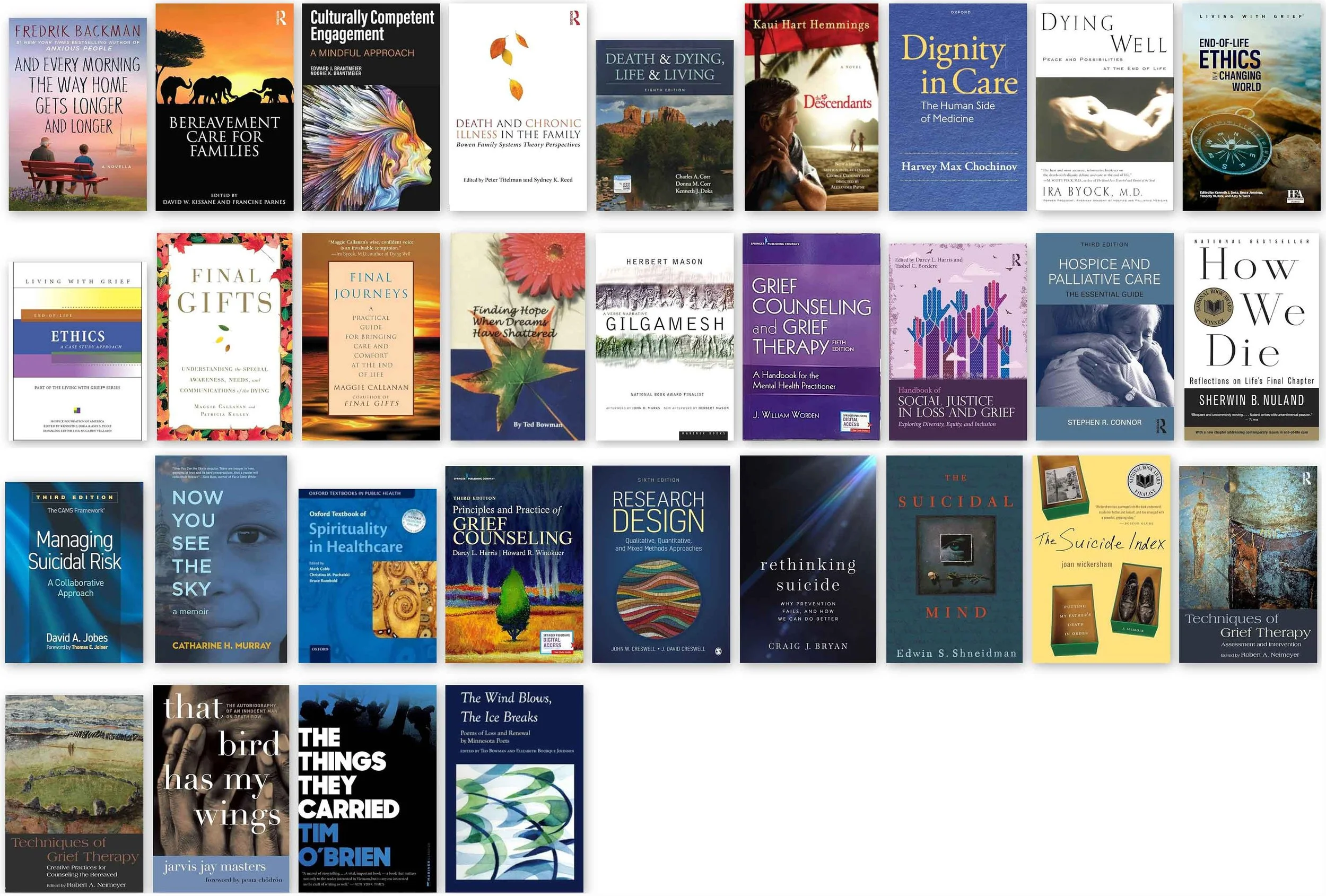
And these are all of the assigned texts from those classes (minus the many journal articles also assigned):
I learned about the Association for Death Education and Counseling (ADEC), a group formed in 1976 by educators and clinicians. They’ve outlined a body of knowledge for thanatology, which nobody needs to treat as doctrine, but it’s interesting contextually. I found that my death doula trainings didn’t offer any historical context of America’s death system, and it was helpful to understand more about where it’s been so I can better serve the movement shaping where it’s going.
What I didn’t like about it
It’s higher education—very fraught! It’s not accessible. It gatekeeps. It makes less and less sense for most people in today’s material conditions. And in that sense, the degree simply means I had the time and resources to pay tuition and complete coursework, which included hours and hours of reading and writing. My privilege and a full-time working partner afforded me the opportunity.
On that note, Servaty-Seib & Chapple (2021) have described how white privilege dominates the field of thanatology itself, along with its neighbors psychology, psychiatry, nursing, medicine, bioethics, palliative care, and hospice. In the third edition of the thanatology handbook, published back in 2021, they called all thanatologists to take note and rectify this. While I was glad to see that my program emphasized systemic injustices, and strongly encouraged its students to accept responsibility for addressing them, it’s important to acknowledge that thanatology still exists within a power structure and has been driven by white middle-class academics.
Finally, I’m struggling to find jobs that accept a master’s in thanatology as a valid credential, at least by itself. I noticed pretty quickly in my program that many others already had credentials that qualified them for jobs, like LCSW, LPN, MDiv, etc., and the thanatology degree was a step to specialization within those fields. There are jobs out there for bereavement coordinators, people who help families navigate death within a hospital system, but they often require those same chaplain, social worker, or nurse credentials.
I wonder about this, and how it locks nonmedical death care into a clinical–religious binary. For example, chaplains are nondenominational, but they must be in good standing with a faith body to be licensed. I didn’t know this until I went to apply for a chaplain position at a hospital near me—I learned I couldn’t actually apply without a letter of recommendation from a faith officially recognized by the U.S. Defense Department. I’ve heard that some humanist chaplains collaborate with the Unitarian Church on this, but this would not be an option for me on principle, despite being very spiritual.
I don’t have any answers about that, or the policy/payment machinations of hospice and why death doulas have thoughtfully resisted certification and formal integration into it. And I’m not sure where I’m headed from here.
I want death workers to be paid with health benefits—some other option besides entrepreneurship with no team or mentorship structure. I know death doulas are responding to the overly medicalized and professionalized death care space, but I don’t know that spinning up a bunch of individual businesses is the only answer to that, and I would love to see more death worker co-op structures working for collective power and living wages.
But as a new death worker and thanatologist, I recognize that I have more to learn about the many moving pieces. So I’m watching it all closely, trying to understand where I might fit (or not) among the options and limitations out there.
References
Edgewood University. (n.d.). Master of Science: Thanatology. https://www.edgewood.edu/academics/programs/master-of-science-in-thanatology/
Federal Trade Commission. (2012). The FTC Funeral Rule. https://consumer.ftc.gov/articles/ftc-funeral-rule
Federici, S. (2004). Caliban and the witch: Women, the body and primitive accumulation. Autonomedia. https://theanarchistlibrary.org/library/silvia-federici-caliban-and-the-witch
Harvey, D. (2005). A brief history of neoliberalism. Oxford Academic. https://doi.org/10.1093/oso/9780199283262.001.0001
Servaty-Seib, H., & Chapple, H. (2021). Introduction. In H. L. Servaty-Seib & H. S. Chapple (Eds.), Handbook of thanatology: The essential body of knowledge for the study of death, dying, and bereavement (3rd ed., pp. 1–13). Association for Death Education and Counseling.
Weber, M. (2002). The Protestant ethic and the spirit of capitalism and other writings. Penguin Classics. (Original work published 1905).
Zinn, H. (2015). A people’s history of the united states. Harper Perennial Modern Classics. (Original work published 1980).