Layers of care work
About the art on this website and the gendered nature of unpaid labor
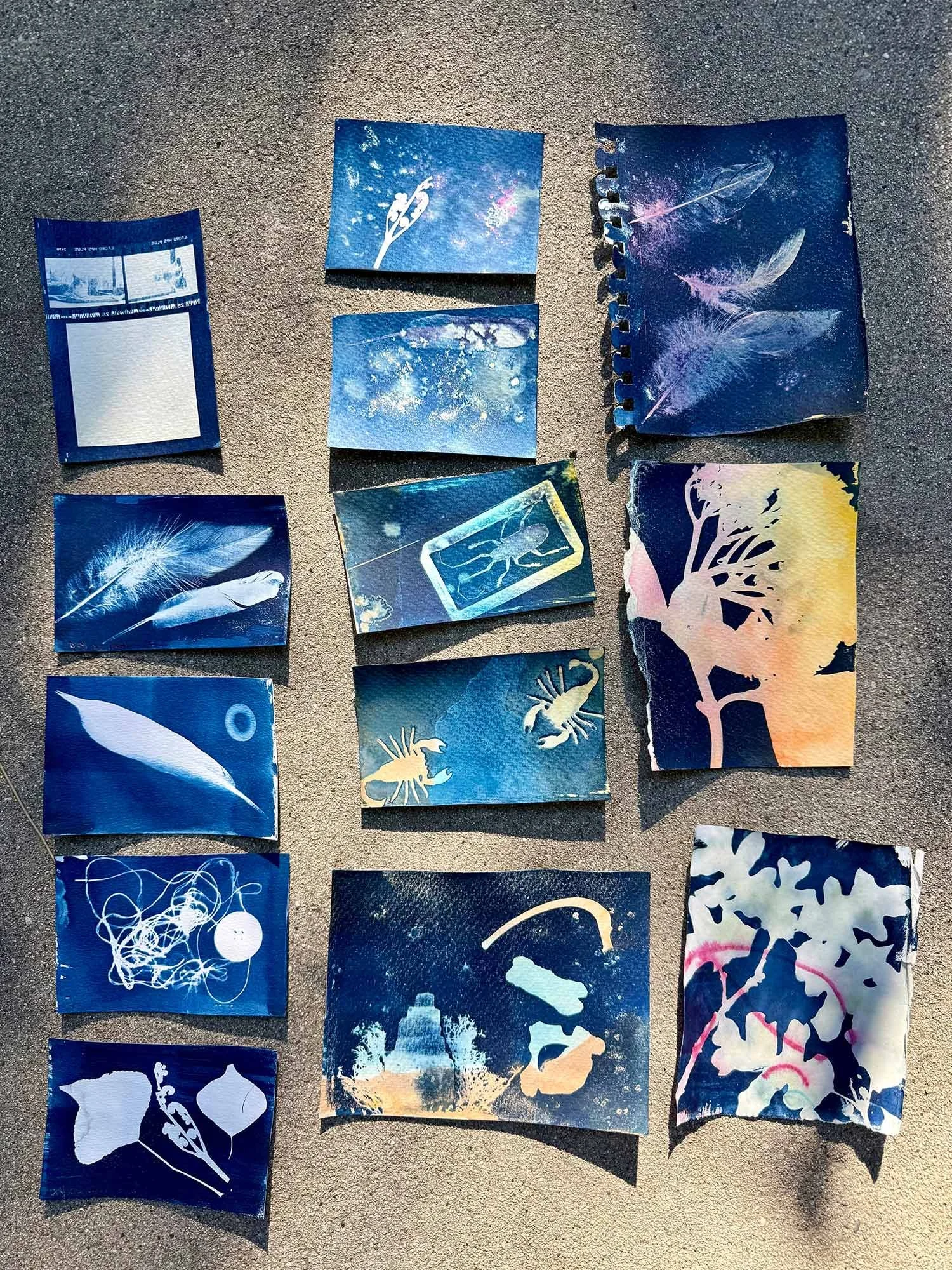
Most of the artwork on this website contains cyanotype prints I made in a workshop this summer, hosted by Venessa Greenheron and Narinder Bazen.
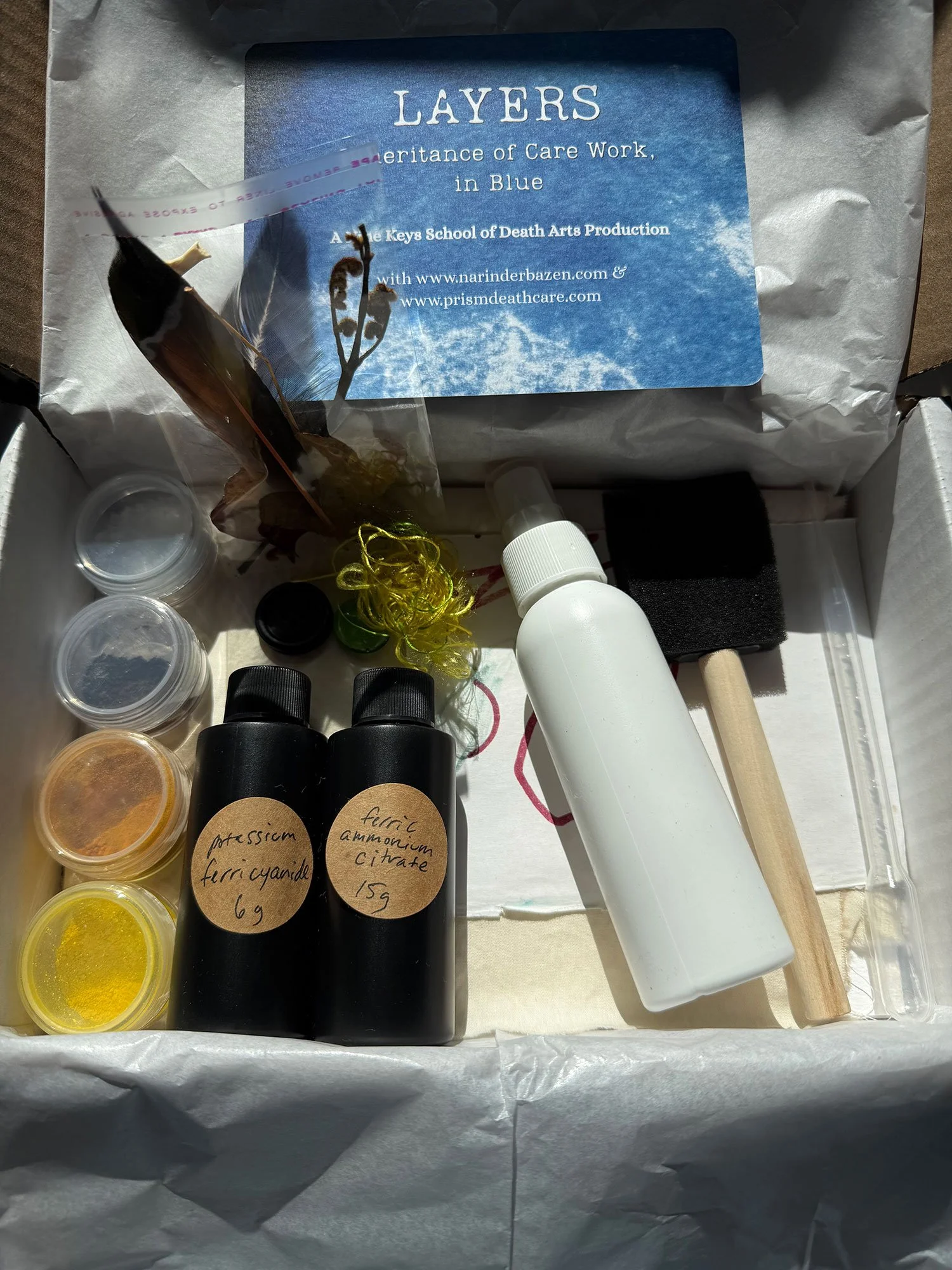
The kit each participant received in the mail. It was perfection.
Called Layers: Inheritance of Care Work in Blue, it explored the enculturation of care work through the process of cyanotype. And it lit me up! They created such a lush learning container by grounding art-making and self-reflection within historical context, and I connected with the whole process pretty intensely.
Before we made art, we discussed care work as a deeply gendered concept shaped by patriarchal power structures (Gott et al., 2025). We looked at womanhood in 19th-century America through the lenses of capitalism and colonization (Garbes, 2022), noting how white women were idealized in the domestic sphere/pushed out of the public sphere, while Black women and Indigenous women were enslaved and displaced.
We also discussed how care work subsidizes the entire economy, and has ever since Western Europe separated economic production from non-economically productive “women’s work” in the industrial revolution (Federici, 2004; Gott et al., 2025). This is called reproductive labor—the work needed to sustain a productive workforce for generations (Garbes, 2022). It includes the unpaid or low-wage work of caring for children, caring for elders, house work, or anything else required to keep a household of people healthy and “productive.”
“The availability of a stable and well-disciplined labor force is an essential condition of production at every stage of capitalist development. This is why housework and the family are the pillars of capitalist production.”
Venessa and Narinder then encouraged us to expose the enculturation of care work in our own histories, keeping all of this in mind. They asked us, What has caregiving obscured for you, and what might be easier to see in the light of the solstice sun?
This prompt brought me to my grandmothers and the flavor of care work our ancestry swims in.
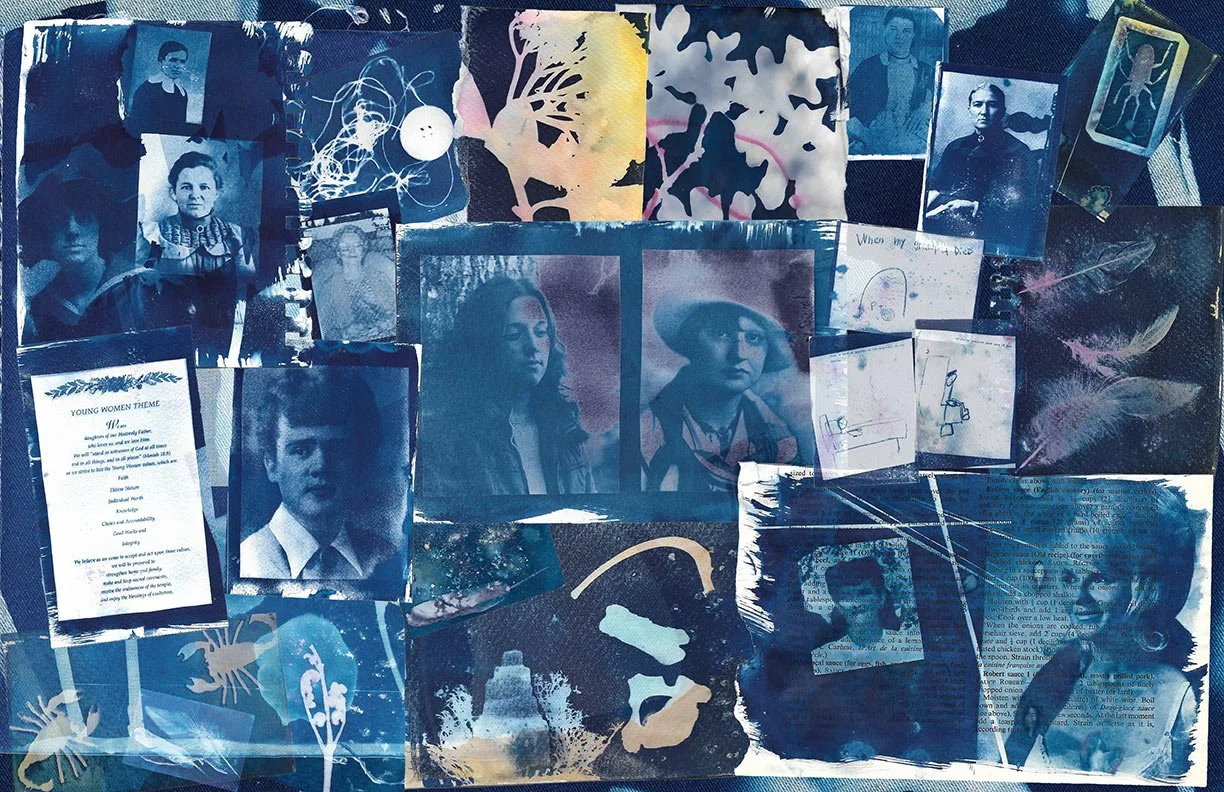
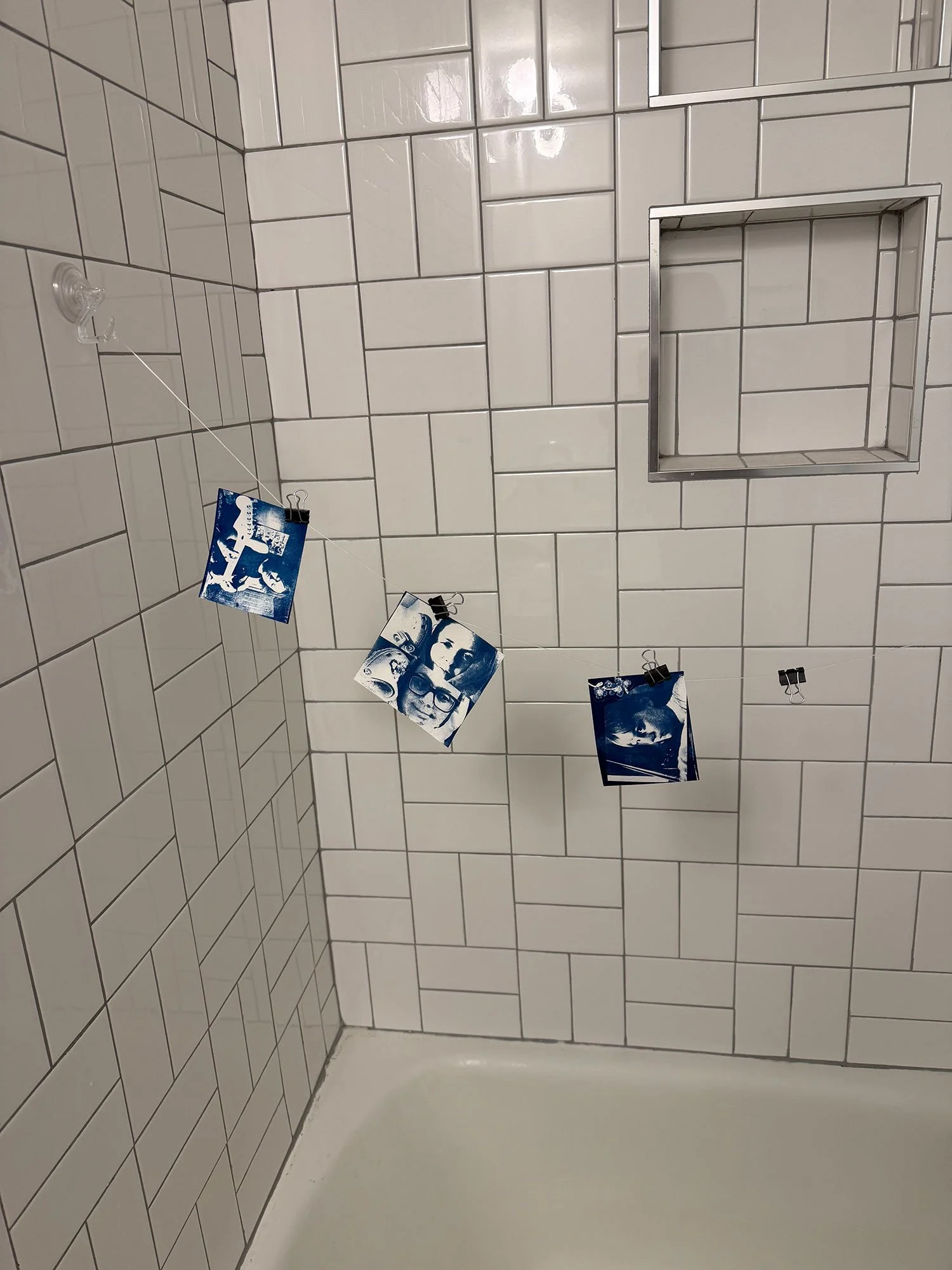
Within these layers of grandmothers lives stories of emigration, polygamy, rape, forced adoption, and severe medical trauma. And those are only the stories I know about. My own addition to that stew is a print of the LDS Young Women theme, as it was written and recited by me every Sunday in the early 2000s, full text below:
We are daughters of our Heavenly Father,
who loves us, and we love Him.
We will stand as witnesses of God at all times
and in all things, and in all places
as we strive to live the Young Women values, which are:
Faith
Divine Nature
Individual Worth
Knowledge
Choice and Accountability
Good Works and
Integrity
We believe as we come to accept and act upon these values,
we will be prepared to:
Strengthen home and family
Make and keep sacred covenants
Receive the ordinances of the temple
And enjoy the blessings of exaltation.
All of the women represented up there in that collage of cyanotypes were taught these things, and to my knowledge, believed in them fully.
“We refuse to elevate to a utopia the misery of our mothers and grandmothers and our own misery as children! When the state does not pay a wage, it is those who are loved and cared for who must pay with their lives. ”
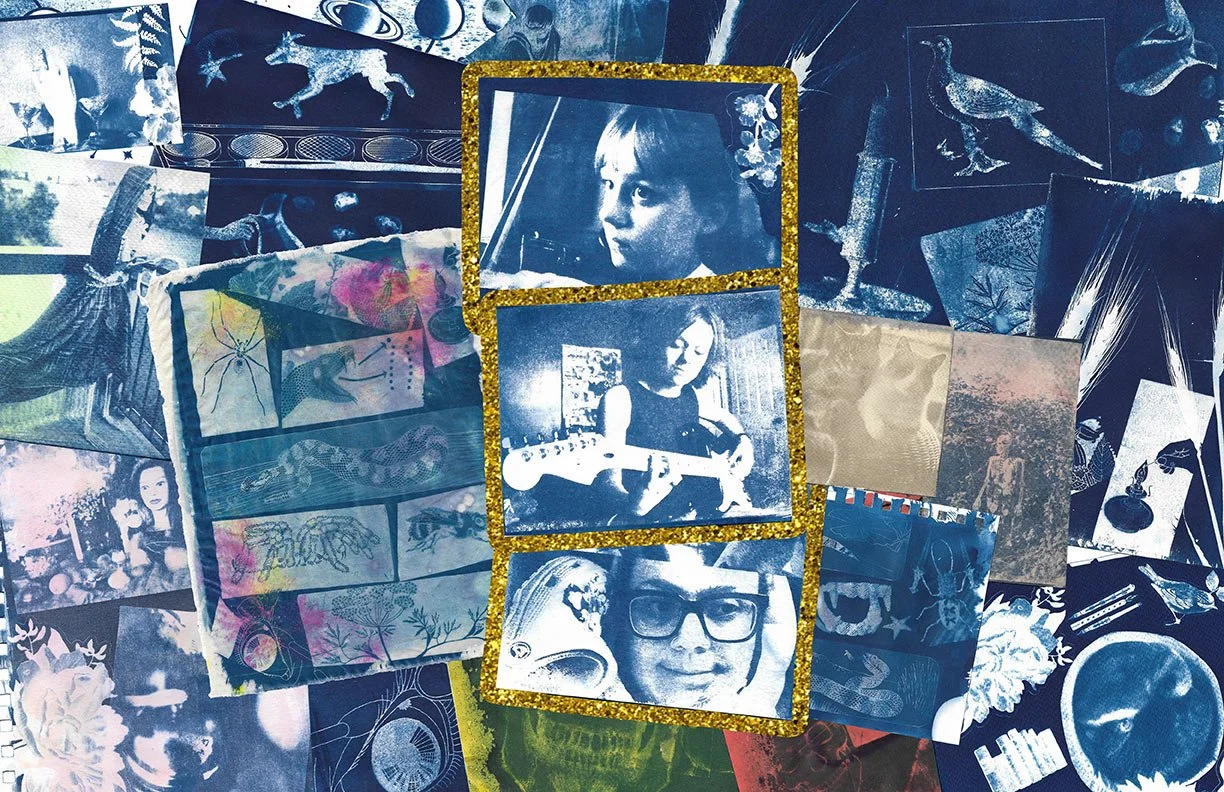
This blended well into the next prompt, which asked us to create a self-portrait removed from any pre-defined caregiving roles. Unlike many in the death work space, I do not come from a care work background, and I do not have children. In hindsight, I threw myself in the opposite direction as a direct response to reciting that theme every week and living under the assumption that I would comply. From a very early age I felt this way, even if I never said it out loud to anyone, including myself. And now that I’m here, trying to serve dying people, I feel awkward and clumsy, and I struggle to perceive myself as someone capable of that work.
That’s what this piece ended up being about—something about my inner child needing to speak up here. I think she knows something I don’t about care work and how I might show up within it.
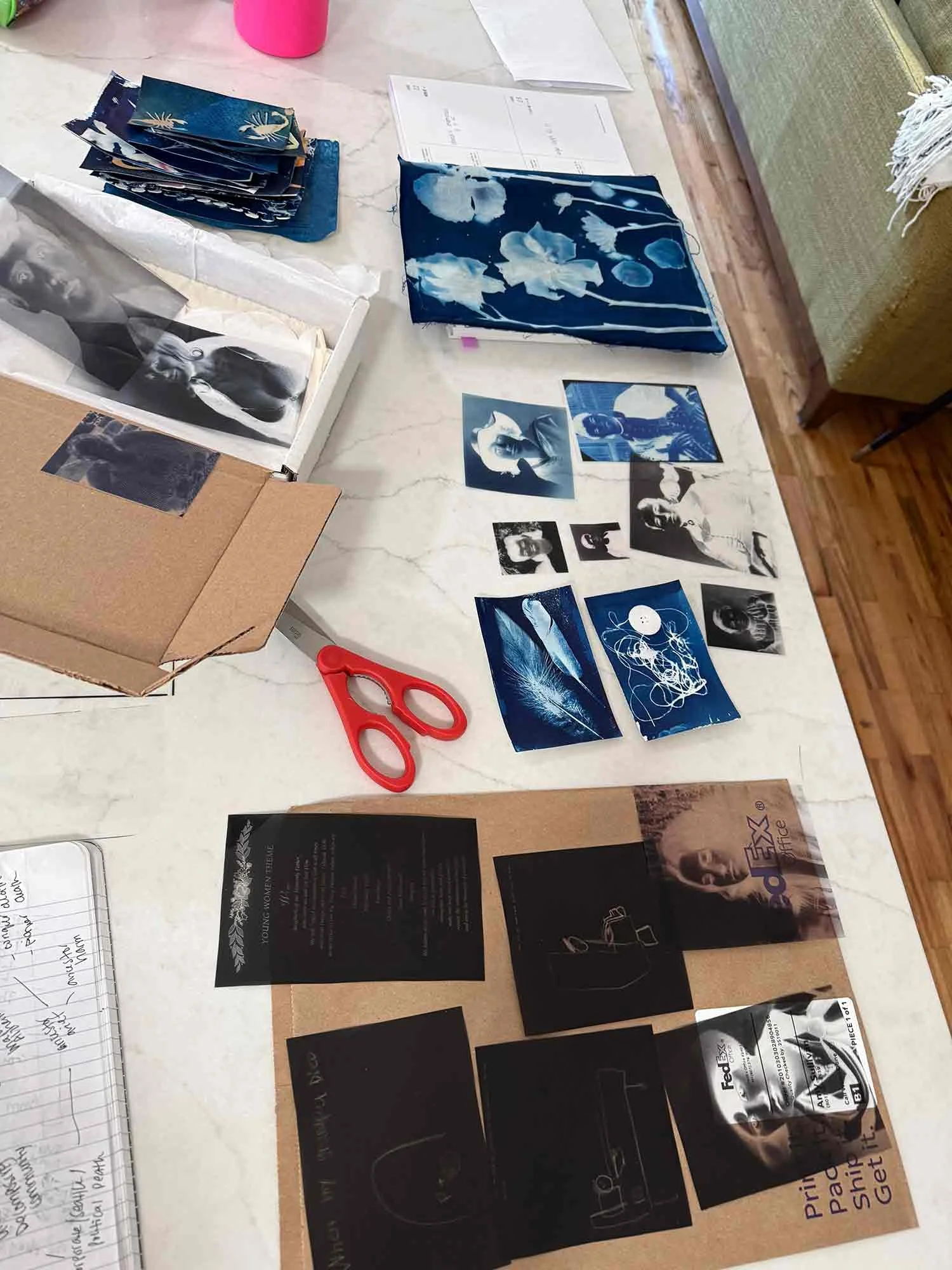
I loved thinking about this stuff as I experimented in my little bathroom cyanotype lab all summer long. It reminded me of summers in the basement darkroom with my dad, back in the 90s, with similar magic and chemical smells unfolding. I really enjoyed trying different techniques for making negatives—the cooking spray/inkjet combo worked! I couldn’t believe it. Packing tape transfers were a treat to make too. And most of all I just appreciated using my hands to make something tangible, after two years of grad school writing on a computer.
In the weeks after the class ended, I’ve been thinking about how palliative care and hospice models heavily rely on unpaid/low-wage care work to function. The bulk of end-of-life care/cost burdens lands on family and friends, most of whom are women—they are more likely than men to provide this unpaid care work, multiple times over the course of their lifetimes, and they typically feel obligated to do so (Gott et al., 2025).
Further, though nearly 1 in 4 American adults act as caregivers, there are no legal recognitions or social protections in place to mitigate the social exclusion and economic disadvantage they face after time away from work (Abulhul, 2026).
And finally, let’s not forget about residential long-term care workers—the majority of them are Black women and immigrant women, being paid a mean salary of $15 an hour, likely without retirement benefits (Martinez Hickey et al., 2022).
As Venessa and Narinder told us, the story of care work is a story about race, power, class, and who gets to write gender norms. And as Gott et al. (2025) wrote, gendered norms around care work negatively impact everyone, so improving end-of-life care must include expanding how care work is conceptualized and valued.
References
Abulhul, Z. (2026). The price of caring: When unpaid caregiving becomes a human rights issue. Human Rights Research Center. https://www.humanrightsresearch.org/post/the-price-of-caring-when-unpaid-caregiving-becomes-a-human-rights-issue
Federici, S. (2004). Caliban and the witch: Women, the body and primitive accumulation. Autonomedia.
Federici, S. (2021). Patriarchy of the wage: Notes on Marx, gender, and feminism. PM Press.
Garbes, A. (2022). Essential labor: Mothering as social change. HarperCollins.
Gott, M., Morgan, T., Williams, L., & Slark, J. (2025). Gender and end of life care work. In D. Clark & A. Samuels (Eds.), Research handbook on end of life care and society (pp. 381–398). Edward Elgar Publishing. https://doi.org/10.4337/9781035317349
Martinez Hickey, S., Sawo, M., & Wolfe, J. (2022). The state of the residential long-term care industry: A comprehensive look at employment levels, demographics, wages, benefits, and poverty rates of workers in the industry. Economic Policy Institute. https://www.epi.org/publication/residential-long-term-care-workers/