
Advance care planning
The process of establishing, documenting, and communicating preferences for end-of-life care

The goal is to establish what you believe constitutes good care at the end of life, based on your own values
Advance care planning entails thinking about:
Who you trust to make medical decisions for you when you can't make them yourself
Types of life-prolonging care you do or don't want when death is near
Your priorities around independence, pain management, and group decision-making
A description I liked from Hemmings (2011): it's like writing vows from your living self to your dying self.
An advance directive is the primary tool for ensuring those wishes are followed
It is a legal document that communicates these wishes to loved ones, medical providers, spiritual advisors, and others who may be involved in decision-making.
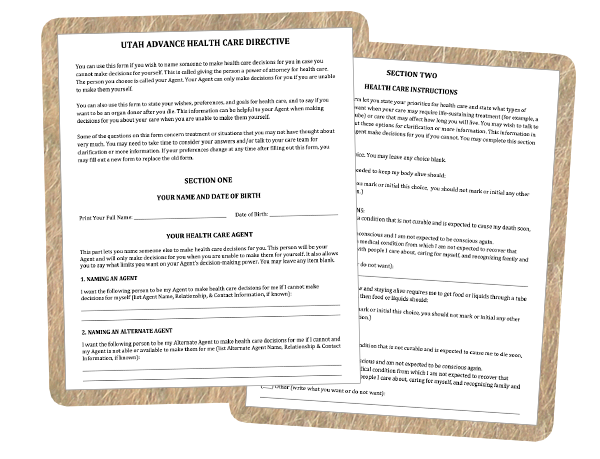
In Utah, this form is called the Utah Advance Health Care Directive.
The most recent version of this form is always on the Utah Commission on Aging website.
About Utah’s form
You'll find two sections in Utah's Advance Health Care Directive form.
Section 1: Naming your health care agent
This is where you name someone to make medical decisions for you in the case that you can't make them yourself. In Utah they are called your health care agent. This is also called giving them a power of attorney for health care.
Section 2: Health care instructions and preferences
This section includes:
Life-prolonging treatment preferences
Priorities around independence, pain management, and collaborative decision-making
Optional power and guidance for your health care agent
Preferences for organ donation
You do not need a notary
You just need the signature of one witness, with stipulations that are listed on the form.

Helpful things to note
As legal forms, advance directives can feel intimidating. Keeping these two things in mind can help.
You can change your advance directive at any time
In fact, the whole process of advance care planning is meant to be an ongoing conversation between patients, their care circle, and medical professionals. As needs change, preferences may shift, and the process of collective dialogue rallies the team around a common understanding of the patient’s goals and values (Jennings, 2012).
Comfort care will always be there
Regardless of the preferences listed in an advance directive for or against certain life-prolonging treatments, patients will always receive comfort care from those around them (Gamino & Ritter, 2009).

Benefits of advance care planning
While completing an advance directive won't make death more predictable or controllable, evidence shows that in end-of-life situations, most people prefer to die peacefully without aggressive life-prolonging treatments (Martins Pereira et al., 2025).
By making those wishes known, advance care planning can:
Decrease death-related anxiety and stress
Ensures wishes are documented and shared with the right people
Increases likelihood that no decisions will be made by unwanted parties
Decreases decision-making burden on others
Improve care and quality of life at the end of life
Facilitates collaborative decisions aligned with goals and values
Reduces unwanted medical treatment
Increases likelihood of dying at home (if that is preferred)
(McAfee et al., 2022; Park et al., 2023; Seiter, 2021)
Advance care planning resources
Intermountain Health
Complete an advance directive in the Intermountain Health app or take a free course to learn more.
Five Wishes
A document that breaks advance planning into five questions.
Pet Peace of Mind
This group provides a care model for pets of seriously ill patients, including helping pets find a loving new home. Partners with Intermountain Health locally.
Will and probate legal assistance
Utah Legal Services
Free legal services for low-income Utahns, plus information on estate planning, senior rights, Medicaid, wills, funerals, etc.
Utah Legal Help
Free legal service sponsored by the Utah State Bar. Connect with a volunteer lawyer by phone or email for up to 30 minutes about your legal issue.
Utah State Courts Self-Help
Forms, laws, and resources on life planning and probate issues.
References
Gamino, L. A., & Ritter, R. H. (2009). Ethical practice in grief counseling. Springer Publishing Company.
Hemmings, K. H. (2011). The descendants: A novel. Random House Trade Paperbacks.
Jennings, B. (2012). From rights to relationships: The ecological turn in ethics near the end of life. In K. J. Doka, A. S. Tucci, C. A. Corr, & B. Jennings (Eds.), End-of-life ethics: A case study approach (pp. 3–22). Hospice Foundation of America.
Martins Pereira, S., Borges, P. J., & Hernández-Marrero, P. (2025). Bioethical frameworks in end of life care decision-making. In D. Clark & A. Samuels (Eds.), Research handbook on end of life care and society (pp. 186–210). Edward Elgar Publishing. https://doi.org/10.4337/9781035317349
McAfee, C. A., Jordan, T. R., Cegelka, D., Polavarapu, M., Wotring, A., Wagner-Greene, V. R., & Hamdan, Z. (2022). COVID-19 brings a new urgency for advance care planning: Implications of death education. Death Studies, 46(1), 91–96. https://doi.org/10.1080/07481187.2020.1821262
Park, S., Kim, H., Jang, M. K., Kim, H., Raszewski, R., & Doorenbos, A. Z. (2023). Community-based death preparation and education: A scoping review. Death Studies, 47(2), 221–230. https://doi.org/10.1080/07481187.2022.2045524
Seiter, C. R. (2021). Benefit, barrier, and self-efficacy messages in advance care planning education materials. Health Communication, 36(11), 1397–1404. https://doi.org/10.1080/10410236.2020.1754601